
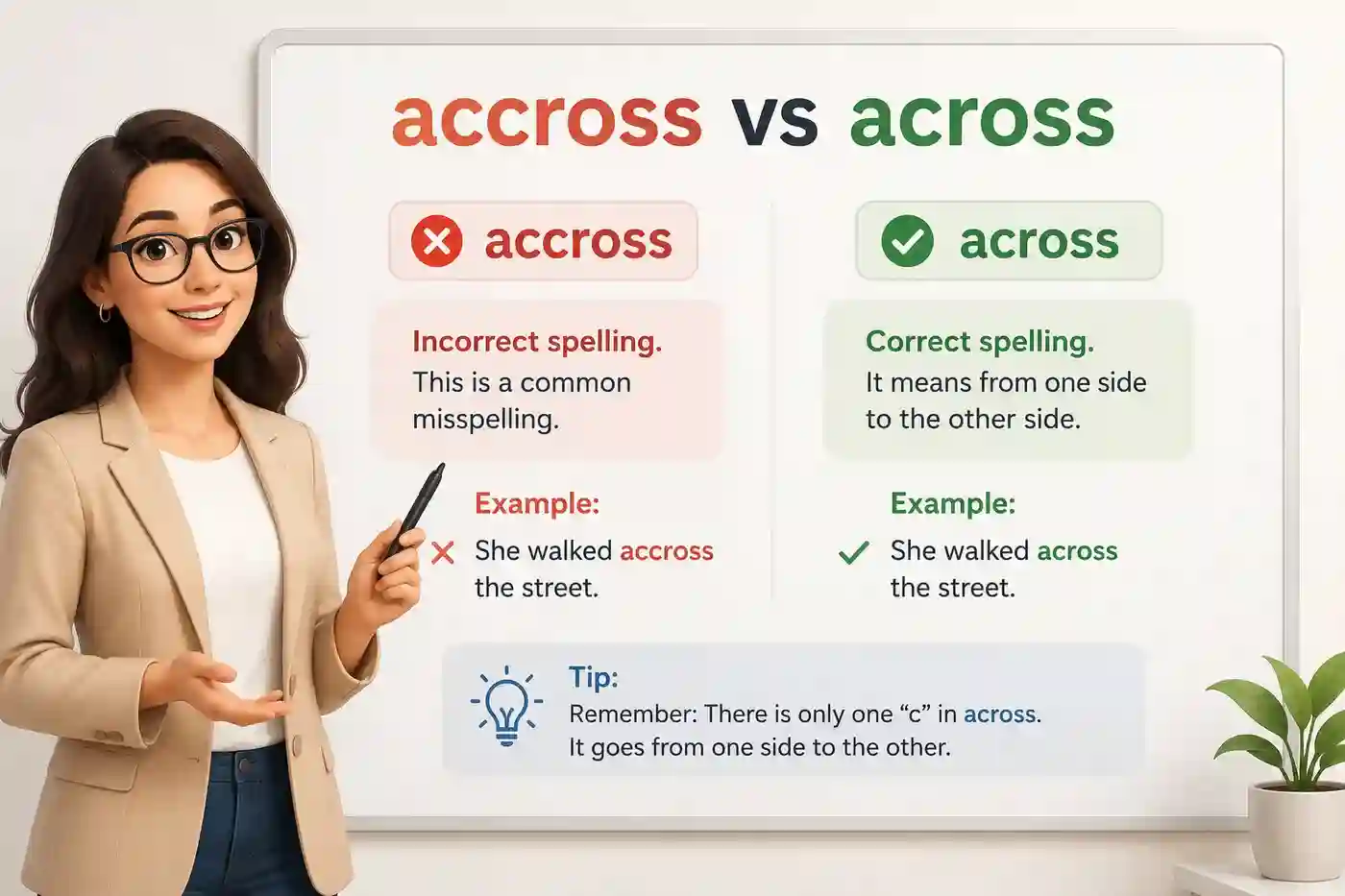
Many people search for accross vs across because they’re unsure which spelling is correct. The confusion is understandable since the two words look almost identical. However, only across is a correct English word. Accross is a common spelling mistake that appears in text messages, emails, school assignments, and even professional writing.
If you’ve ever paused while typingIntroduction
Many people search for accross vs across because they’re unsure which spelling is correct. The confusion is understandable since the two words look almost identical. However, only across is a correct English word. Accross is a common spelling mistake that appears in text messages, emails, school assignments, and even professional writing.
If you’ve ever paused while typing across or wondered if accross is an acceptable alternative, you’re not alone. This spelling error happens to native English speakers and English learners alike because the extra c can seem natural when writing quickly.
This guide explains the difference between accross and across in simple English. You’ll learn which spelling is correct, why people make this mistake, how to remember the right form, and how to use across confidently in everyday writing.or wondered if accross is an acceptable alternative, you’re not alone. This spelling error happens to native English speakers and English learners alike because the extra c can seem natural when writing quickly.
This guide explains the difference between accross and across in simple English. You’ll learn which spelling is correct, why people make this mistake, how to remember the right form, and how to use across confidently in everyday writing.
Quick Answer
Across is the correct spelling. Accross is a common misspelling and is not recognized as a standard English word. Use across when referring to movement from one side to another, something extending over an area, or something happening throughout a place or group.
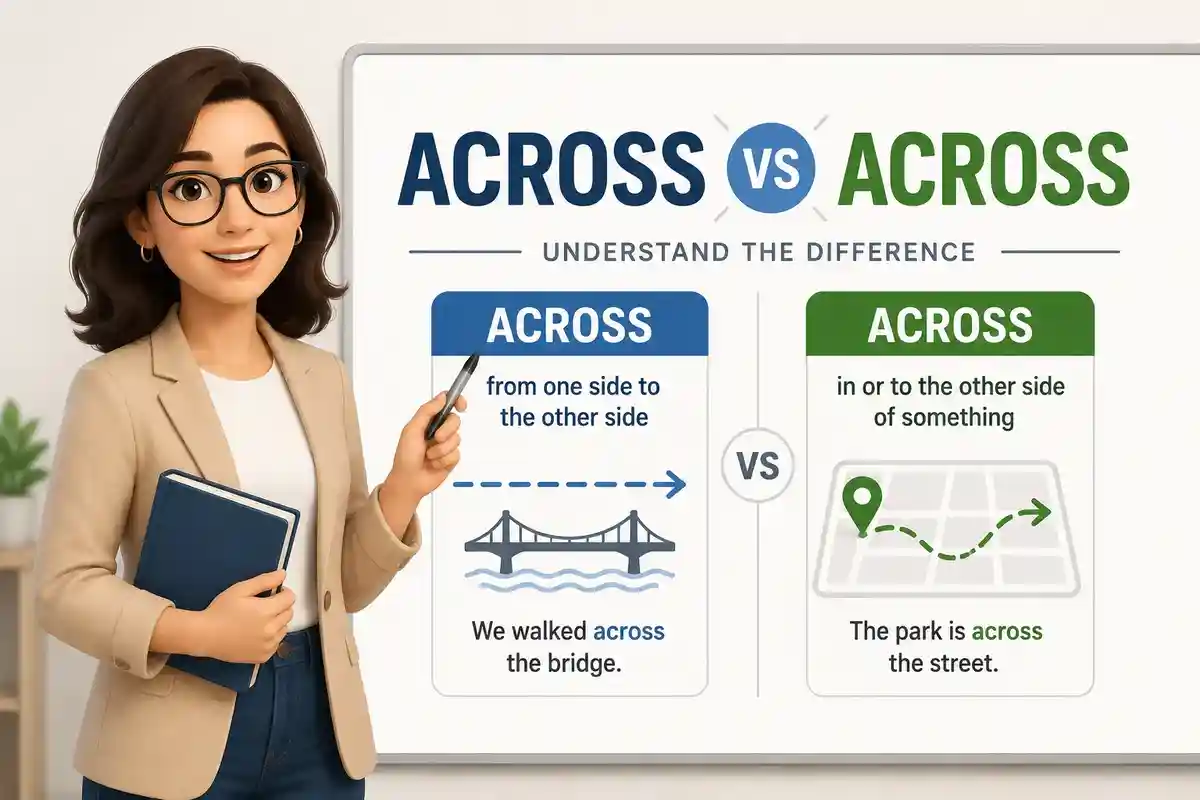
Accross Vs Across Comparison
| Feature | Accross | Across |
|---|---|---|
| Spelling | Incorrect | Correct |
| Dictionary entry | No | Yes |
| Part of speech | None | Preposition Adverb |
| Used in standard English | No | Yes |
| Appears in formal writing | No | Yes |
| Example | ❌ She walked accross the street. | ✔ She walked across the street. |
What Does Across Mean
Across is a common English word that works mainly as a preposition and an adverb. It describes movement, position, or something that extends from one side to another. It can also refer to something happening throughout an area, organization, or group.
Because it has several uses, across appears in almost every type of English writing, from everyday conversations to books, news articles, and business communication.
Simple Definition
Across means from one side to the other, on the opposite side, throughout an area, or extending over something.
Common Uses Of Across
The meaning changes slightly depending on the context.
Movement From One Side To Another
- She walked across the road.
- The children ran across the field.
- We swam across the river.
In these examples, someone or something moves from one side to the other.
Position On The Opposite Side
- The grocery store is across the street.
- Their office is across the hall.
- We live across the river.
Here, across describes location instead of movement.
Throughout An Area
- The news spread across the country.
- The company has offices across the state.
- Her books are popular across the world.
In these examples, across means throughout or over a wide area.
Shared By A Group
- The new policy applies across all departments.
- Prices increased across the industry.
- The campaign reached customers across every age group.
Here, the word shows something affecting many people or places.
Common Collocations With Across
These combinations appear frequently in natural English.
- Across the street.
- Across the country.
- Across the world.
- Across the room.
- Across the table.
- Across the river.
- Across the hall.
- Across the border.
- Across the city.
- Across all departments.
- Across generations.
- Across cultures.
Learning these common combinations helps your writing sound more natural.
Expert Editorial Insight
Many writers think of across only as a word describing movement. In reality, it often describes reach or coverage. For example, a business can operate across multiple states, or a survey can include participants across different age groups. Recognizing these broader uses makes your writing more accurate and more flexible.
Is Accross A Real Word
No. Accross is not a real English word.
It does not appear in standard dictionaries because it is simply a misspelling of across. If you type accross, most spell check tools and grammar programs will recommend replacing it with across.
The mistake usually happens because English contains many words with double consonants. Writers sometimes assume across follows the same pattern, but it does not.
Why People Write Accross
Several factors make this spelling mistake common.
- The word is typed frequently.
- Double consonants are common in English.
- Fast typing increases spelling errors.
- Many people spell the word from memory instead of visual recognition.
Although the mistake is understandable, it is still considered incorrect in formal and informal writing.
Editorial Insight
Professional editors rarely see accross in published work because proofreading catches it before publication. When it appears, it is treated as a straightforward spelling error rather than a grammar mistake.
Which Form Is Correct
The answer is simple.
Across is always the correct spelling.
Accross is always incorrect.
There are no situations where accross is accepted in American English, British English, Canadian English, Australian English, or any other standard variety of English.
Compare these examples.
✔ She walked across the bridge.
❌ She walked accross the bridge.
✔ Our products are sold across Europe.
❌ Our products are sold accross Europe.
✔ The message spread across social media.
❌ The message spread accross social media.
If you’re unsure while writing, remember that dictionaries recognize only across.
Key Differences Between Accross And Across
Although these words differ by only one letter, only one belongs to standard English.
| Accross | Across |
|---|---|
| Incorrect spelling | Correct spelling |
| Not found in dictionaries | Found in all major dictionaries |
| Never used in edited writing | Used in every type of English writing |
| Considered a spelling mistake | Accepted in formal and informal English |
A simple comparison makes the difference easy to remember.
- Across is the correct word that appears in dictionaries, books, newspapers, and professional writing.
- Accross is a spelling mistake caused by adding an extra c.
- If you’re writing for school, work, publishing, or online content, always use across.
Once you remember that across contains only one c and two s letters, this mistake becomes much easier to avoid.
Grammar Rules
Understanding how across works in a sentence helps you use it naturally.
Across Functions As A Preposition
Most often, across introduces a noun and shows movement, position, or direction.
Examples:
- She walked across the street.
- We drove across the country.
- The dog jumped across the fence.
In each sentence, across connects the action to a place.
Across Can Also Function As An Adverb
Sometimes across stands alone without an object.
Examples:
- Come across when you’re ready.
- He swam across without stopping.
- The ball rolled across.
In these sentences, the destination is understood from the context.
Across Does Not Function As A Noun Or Verb
Unlike many English words, across does not work as a noun or a verb.
For example:
❌ We acrossed the bridge.
✔ We walked across the bridge.
✔ We crossed the bridge.
Notice the difference between across and crossed.
- Across is a preposition or adverb.
- Cross is the verb.
Understanding this distinction prevents another common writing mistake.
Quick Grammar Test
Ask yourself this question.
Is the word showing movement, direction, position, or something extending over an area?
If the answer is yes, across is probably the correct choice.
If you’re simply trying to decide between accross and across, the answer is even easier.
Always choose across.
Pronunciation
Many spelling mistakes happen because people spell words based on how they sound.
Fortunately, across has a consistent pronunciation.
| Word | IPA | Simple Pronunciation |
|---|---|---|
| Across | /əˈkrɔːs/ or /əˈkrɑːs/ | uh KROSS |
The first vowel may sound slightly different depending on the accent, but the spelling remains the same in every major variety of English.
Notice that the pronunciation gives no clue suggesting an extra c. The word contains one c followed by a double s.
Spelling Rules
The spelling of across follows a simple pattern.
It contains:
- One a.
- One c.
- One r.
- One o.
- Two s letters.
Many writers accidentally reverse this pattern by adding an extra c instead of remembering the double s.
Remember The Double S
A useful spelling reminder is this.
Across has one c but two s letters.
Think of the word stretching from one side to another. The two s letters can remind you of the two sides being connected.
Proofreading Tip
If you often type quickly, search your document for accross before publishing it. Because the mistake is so common, many professional writers include it in their personal proofreading checklist.
Reading slowly during your final review also helps you catch spelling errors that your eyes might skip during fast reading.
Usage Guide
The word across appears in many situations, but its core idea never changes. It always describes movement, position, reach, or something extending from one side to another. Once you understand that central meaning, using it correctly becomes much easier.
The most important point to remember is that across is the only correct spelling. If you find yourself typing accross, simply remove the extra c.
Showing Movement Of Accross vs Across
One of the most common uses of across describes movement from one side to another.
Examples:
- She walked across the parking lot.
- The children ran across the playground.
- We drove across the bridge.
- The cat jumped across the fence.
In each sentence, someone or something moves from one side to another.
Describing Location Of Accross vs Across
Across can also describe where something is located.
Examples:
- The pharmacy is across the street.
- His office is across the hall.
- They live across the river.
- Our neighbors are across the road.
Here, no movement happens. The word simply describes position.
Showing Something Spread Over A Large Area About Accross vs Across
Another common use refers to something happening throughout a place or region.
Examples:
- The company has stores across the country.
- Heavy rain fell across the state.
- The campaign reached voters across the city.
- Her research is respected across the industry.
In these examples, across has a meaning similar to throughout.
Showing Something Shared By A Group About Accross vs Across
The word also describes something that applies to many people, teams, or organizations.
Examples:
- The policy applies across every department.
- Prices increased across the market.
- The program is available across all campuses.
- The update improved performance across every device.
This usage is especially common in business and technical writing.
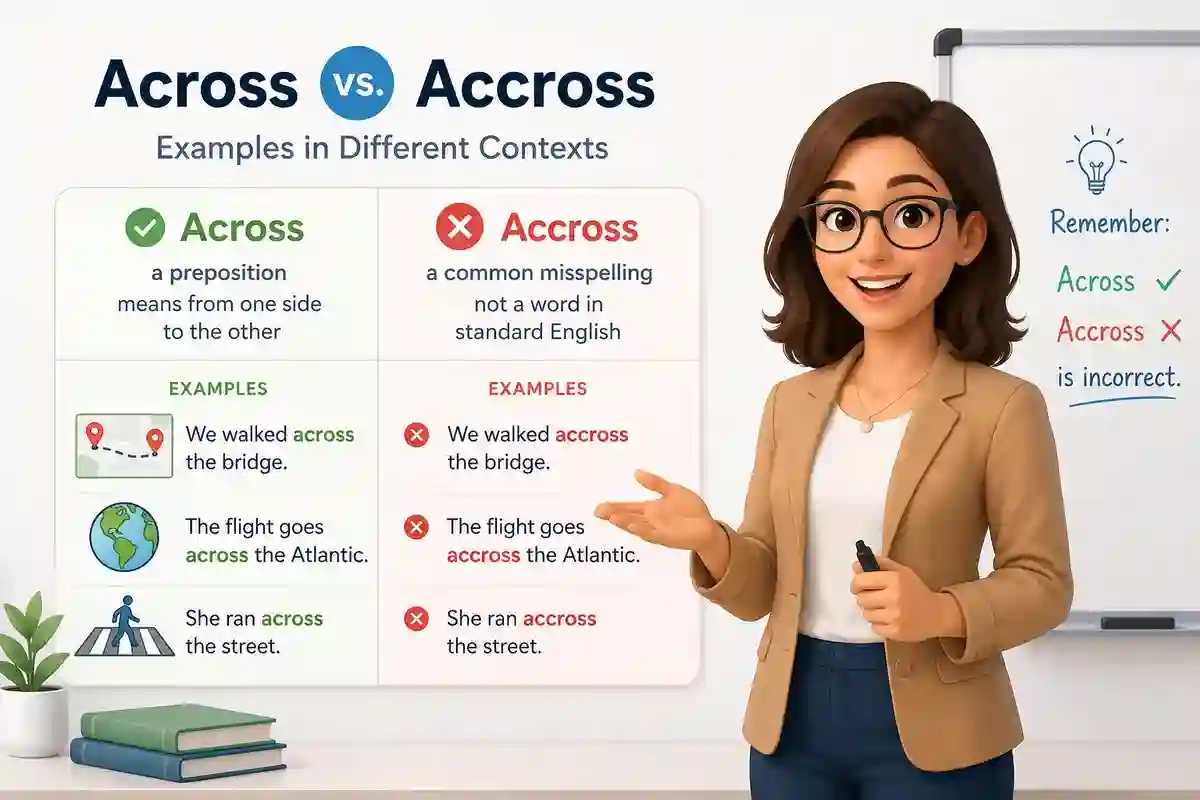
Examples In Different Contexts About Accross vs Across
Looking at real world examples makes the correct usage much easier to remember.
Usage Of Accross vs Across In Everyday Conversation
- We walked across the park after dinner.
- My friend lives across the street.
- The dog ran across the yard.
- I could hear music from across the room.
Use Of Accross vs Across In School
- Students walked across the campus together.
- The teacher wrote the answer across the board.
- The news spread quickly across the school.
- Our project included data from schools across the district.
Use Of Accross vs Across In Workplace
- The company expanded across North America.
- Teams worked together across different offices.
- The announcement was shared across the organization.
- Employees collaborated across several departments.
Travel
- We drove across the desert.
- They sailed across the lake.
- The train traveled across the country.
- Our guide led us across the mountain trail.
Usage Of Accross vs Across In Technology
- The update rolled out across all devices.
- The app works across different operating systems.
- Data is synchronized across multiple platforms.
- Users can access their accounts across various devices.
Sports
- The player passed the ball across the field.
- Fans traveled across the country to watch the game.
- The coach shouted from across the court.
- The tournament attracted teams from across the region.
Common Mistakes About Usage Of Accross vs Across
Most errors involve spelling, but there are a few usage mistakes worth knowing as well.
Mistake One
❌ We walked accross the street.
✅ We walked across the street.
Why it is incorrect.
Accross is not a standard English word.
Mistake Two
❌ The company operates accross Europe.
✅ The company operates across Europe.
Why it is incorrect.
Only across appears in standard dictionaries.
Mistake Three
❌ We acrossed the bridge.
✅ We crossed the bridge.
Or
✅ We walked across the bridge.
Why it is incorrect.
Across is not a verb. The verb is cross.
Mistake Four
❌ She is acrossing the road.
✅ She is crossing the road.
Why it is incorrect.
Use crossing, not acrossing.
Mistake Five
❌ The sign was through the street.
✅ The sign was across the street.
Why it is incorrect.
Across describes something located on the opposite side.
Why People Get Confused About Usage Of Accross vs Across
The spelling mistake looks simple, but several factors make it surprisingly common.
English Has Many Double Consonants
Words like address, accommodate, success, and occasion contain double letters. After seeing so many examples, writers naturally assume across follows the same pattern.
It does not.
The correct spelling has one c and two s letters.
People Type Faster Than They Think
Frequent words are often typed automatically.
Instead of carefully spelling each letter, your fingers rely on muscle memory. That increases the chance of adding an extra c.
Pronunciation Does Not Reveal The Mistake
The pronunciation of across does not clearly indicate how many c letters it contains.
Because the spoken form sounds the same, many writers rely on memory instead of visual recognition.
Readers Focus On The Shape Of The Word
Research on reading shows that people recognize familiar word shapes very quickly. During fast reading, the brain may overlook an extra letter because the overall appearance still looks familiar.
That is why proofreading slowly remains one of the most effective editing habits.
Memory Tricks
A simple memory trick is often all you need to stop making the same spelling mistake.
Remember The Letter Pattern
Think of this formula.
One C. Two S letters.
If you remember nothing else, remember that pattern.
Picture Crossing A Road
Imagine yourself walking from one side of the street to the other.
The road has two sides, so think of the two s letters at the end of across.
There is only one path connecting them, so there is only one c.
Compare It With Cross
Notice something interesting.
- Cross.
- Across.
Both words use only one c.
Since cross already contains one c, adding the prefix a does not create another one.
Build A Proofreading Habit About Usage Of Accross vs Across
Whenever you finish writing, search your document for accross.
Many experienced editors keep a short list of words they commonly misspell. Adding accross to that list can prevent future mistakes.
Regional Usage Of Accross vs Across
The spelling of across does not change from one English speaking country to another.
American English, British English, Canadian English, Australian English, and New Zealand English all use the same spelling.
Usage Of Accross vs Across In American English
Examples:
- We drove across Texas.
- Stores across the country offered discounts.
Usage Of Accross vs Across In British English
Examples:
- We travelled across England.
- The news spread across the United Kingdom.
Usage Of Accross vs Across In Canadian English
Examples:
- The company operates across Canada.
- Snow fell across the province.
Usage Of Accross vs Across In Australian English
Examples:
- They travelled across Australia.
- The campaign reached communities across the state.
Although vocabulary sometimes changes between countries, the spelling of across remains exactly the same.
Etymology
Understanding where a word comes from often makes its spelling easier to remember.
The word across developed in Middle English from the combination of the prefix a, meaning on or in, and cross, referring to movement from one side to another.
Over time, the two parts combined to form the modern spelling across.
The history also explains why the word contains only one c. It comes directly from cross, which itself has only one c followed by two s letters. The spelling has remained stable for centuries.
Usage Of Accross vs Across In Expert Language Insights
Professional editors rarely think about across in isolation. They look at the role it plays in the sentence.
If the word introduces movement, direction, location, or something extending throughout an area, across is usually the right choice. If the sentence needs a verb, however, editors switch to cross, crosses, crossed, or crossing instead.
Another important observation is that accross almost never survives professional editing. It is one of the first spelling mistakes editors notice because it appears so frequently. Developing the habit of checking common spelling errors before publishing can improve the overall quality of your writing.
Related Words Synonyms Antonyms Collocations Idioms And Confusing Terms
Understanding related vocabulary helps you use across more naturally.
Synonyms Of Across
Depending on the sentence, these words may express a similar idea.
- Throughout.
- Over.
- From side to side.
- On the opposite side of.
- Beyond.
- Throughout the area.
Always choose the synonym that best matches the context.
Antonyms Of Across
Possible opposites include:
- Along.
- Beside.
- Near.
- Around.
- On this side.
The best antonym depends on the sentence.
Common Collocations With Across
Native speakers use these combinations frequently.
- Across the street.
- Across the country.
- Across the world.
- Across the room.
- Across the table.
- Across the hall.
- Across the river.
- Across the border.
- Across the city.
- Across the region.
- Across the organization.
- Across generations.
Learning these collocations makes your English sound more natural.
Idioms And Expressions With Across
Several common English expressions include across.
- Come across as.
- Come across.
- Get across.
- Put across.
- Across the board.
- Across the pond.
These expressions have meanings that go beyond the literal idea of movement, so learning them individually can strengthen your vocabulary.
Related Confusing Word Pairs Usage Of Accross vs Across
If you often misspell across, you may also find these word pairs helpful.
- Accept and except.
- Affect and effect.
- Advice and advise.
- Principal and principle.
- Then and than.
- Lose and loose.
- Stationary and stationery.
- Farther and further.
- Compliment and complement.
- Who’s and whose.
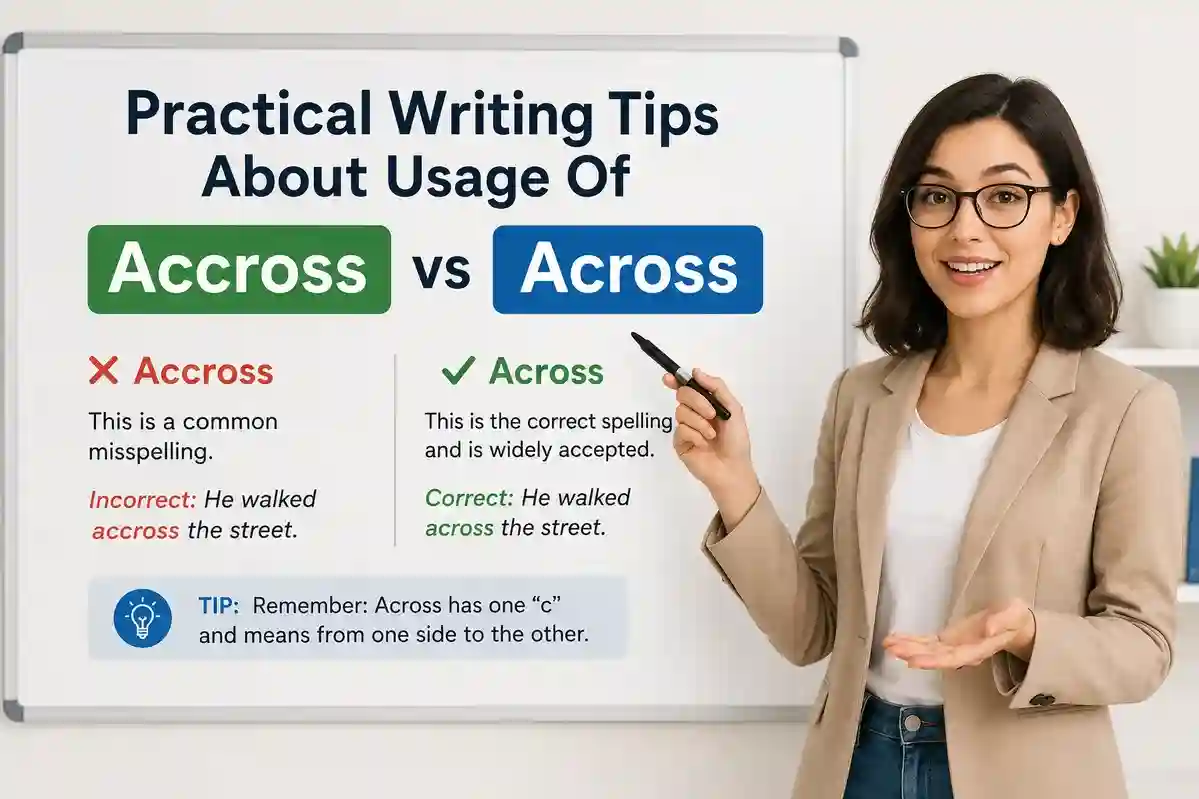
Practical Writing Tips About Usage Of Accross vs Across
Strong writers build simple habits that reduce spelling mistakes before they happen.
These tips can help you use across correctly every time.
- Remember that across has one c and two s letters.
- Read slowly during your final proofreading pass.
- Don’t rely entirely on spell check.
- Compare across with cross to reinforce the correct spelling.
- Watch for common typing mistakes when writing quickly.
- Learn common collocations because familiar phrases are easier to spell correctly.
- Practice writing the word in complete sentences instead of memorizing it by itself.
- Keep a personal list of words you commonly misspell and review it regularly.
Frequently Asked Questions
Is Accross A Correct Spelling
No. Accross is always incorrect. The only correct spelling is across. Standard English dictionaries do not recognize accross as a valid word, and it should never appear in formal or informal writing.
Why Do People Spell Across As Accross
This mistake usually happens because many English words contain double consonants. Writers often assume across follows the same pattern and add an extra c by mistake. Typing quickly and relying on memory instead of proofreading also contribute to the error.
Is Across A Preposition Or An Adverb
It can be both.
As a preposition, across is followed by a noun or pronoun.
Examples:
- We walked across the bridge.
- The library is across the street.
As an adverb, it stands on its own.
Examples:
- The swimmer made it across.
- Come across when you’re ready.
The correct role depends on how the word is used in the sentence.
Can Across Be Used As A Verb
No. Across is never used as a verb.
If your sentence needs a verb, use cross instead.
Correct examples:
- We crossed the road.
- She is crossing the bridge.
- They cross the river every morning.
Is The Spelling Different In British English
No.
American English, British English, Canadian English, Australian English, and other major varieties of English all use the same spelling.
Across is correct everywhere.
What Is The Difference Between Across And Cross
Although the words are closely related, they have different grammatical functions.
Across is a preposition or adverb that describes movement, position, or something extending over an area.
Cross is usually a verb that means to move from one side to another.
Examples:
- We walked across the street.
- We crossed the street.
Both sentences are correct, but the words perform different jobs.
Is Across Used Only For Physical Movement
No.
While across often describes movement, it can also show that something extends throughout an area or applies to many people or places.
Examples:
- The campaign reached customers across the country.
- The new policy applies across every department.
- Her research is respected across the scientific community.
In these examples, nothing is physically moving from one side to another.
Does Spell Check Always Catch Accross
Most spell check tools identify accross as a misspelling and suggest across. Still, proofreading remains important because no writing tool catches every mistake. Reading your work carefully before publishing is always a good habit.
How Can I Remember The Correct Spelling
The easiest trick is to remember this pattern.
Across has one c and two s letters.
You can also connect the word to cross, which also contains one c. Since across is built from cross, adding another c would create an incorrect spelling.
Conclusion
The difference between accross and across is simple once you know the correct spelling. Across is the only accepted form in standard English, while across is a common spelling mistake caused by adding an extra c. No dictionary recognizes across, and it should never appear in professional, academic, or everyday writing.
A good way to remember the correct spelling is to think of the word cross. It contains one c and two s letters, and across follows the same pattern. If you’re writing about movement from one side to another, a location on the opposite side, or something that extends throughout an area, across is always the right choice.
Building the habit of proofreading common spelling mistakes can make a noticeable difference in the quality of your writing. With a little practice, you’ll stop second guessing yourself and use across confidently every time.

Founding Editor
Maya spent six years as a copyeditor at a regional newspaper before starting Grammist, which is where the “answer first” format came from: newsroom style guides don’t have room for a preamble.
She writes and reviews most of the word-pair and spelling entries, and has final say on anything that goes out under the Grammist name.