
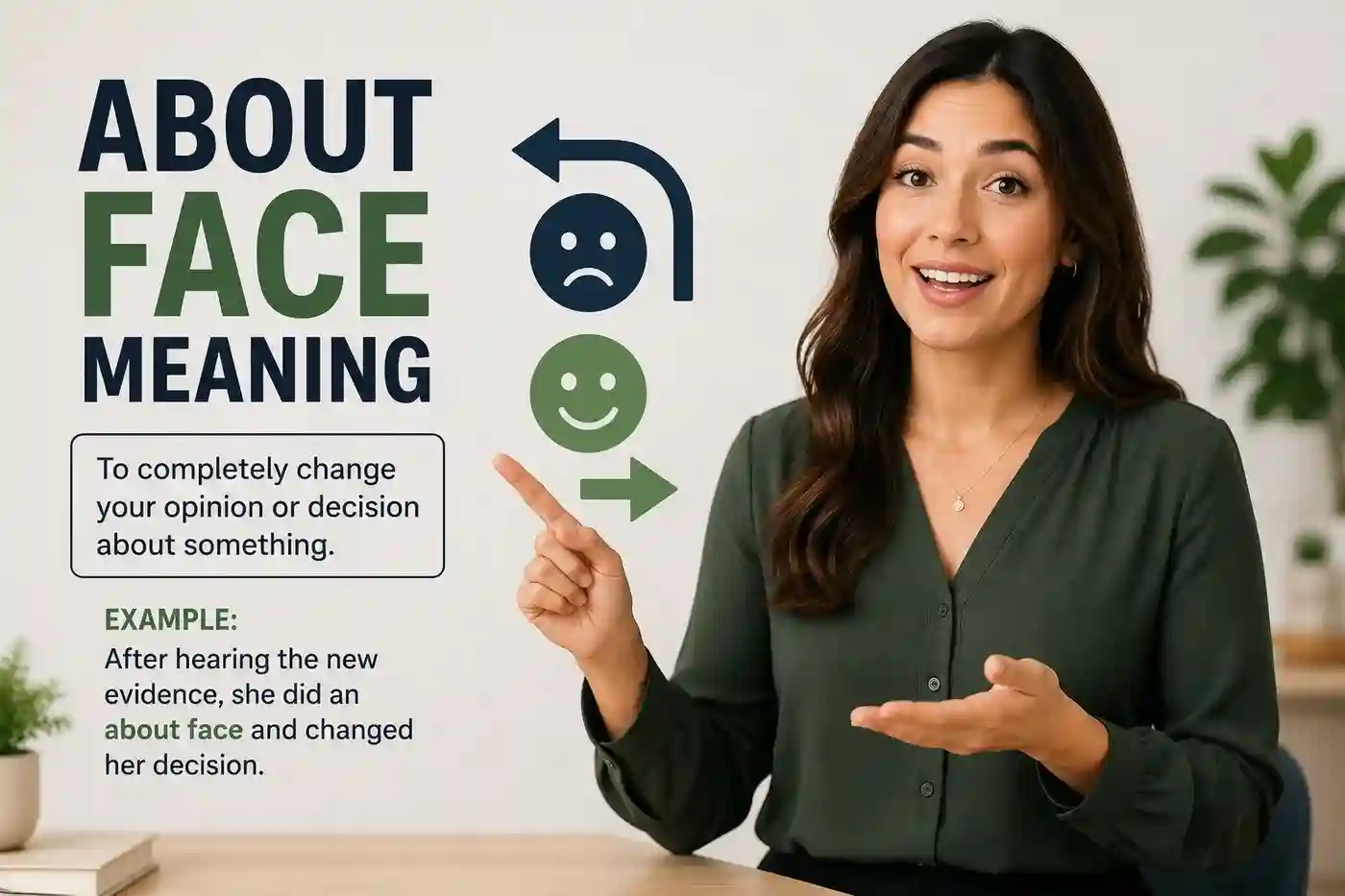
If you’ve ever heard someone say a company made a meaning about face or a politician did a meaning about face on an important issue, you might have wondered what the phrase really means. At first glance, it sounds like it has something to do with someone’s face. In reality, the expression has nothing to do with facial features. Instead, it describes a complete change in direction, opinion, or behavior.
The phrase about face began as a military command, but today it appears in everyday conversations, news reports, business discussions, sports commentary, and political analysis. Writers and speakers use it to describe someone who suddenly changes course after previously moving in the opposite direction.
This guide explains the meaning of about face in plain English. You’ll learn where the expression came from, how it’s used in modern English, its grammar, pronunciation, and the difference between its literal military meaning and its figurative use. By the end, you’ll know exactly when this idiom fits naturally and when another expression works better.
Quick Answer
About face is an idiom that means to make a complete or sudden change in direction, opinion, decision, or behavior. The phrase originally came from the military command that instructs soldiers to turn 180 degrees. Today, it is commonly used to describe someone reversing their position or changing course completely.
What Does About Face Mean
About face has two closely related meanings. The original meaning comes from the military, while the modern figurative meaning is used in everyday English.
Simple Definition Of Meaning About Face
About face means a complete change in direction or a sudden reversal of opinion, attitude, policy, or action.
The phrase often suggests that someone has abandoned their previous position and adopted a new one.
The Figurative Meaning About Face
In modern English, about face is usually an idiom. It describes a major shift rather than a small adjustment.
For example:
- A company may make an about face after realizing its business strategy isn’t working.
- A politician may do an about face after public opinion changes.
- Someone may make an about face on a personal decision after learning new information.
In each case, the person or organization changes direction in a noticeable way.
The Literal Military Meaning About Face
The phrase originally referred to a military drill command.
When a commanding officer gives the order about face, soldiers immediately turn 180 degrees to face the opposite direction. The movement is precise, disciplined, and happens as one coordinated action.
This literal meaning gave rise to the figurative expression that people use today. Just as soldiers physically turn around, a person can figuratively turn around by changing an opinion, decision, or course of action.
Expert Editorial Insight About Face Meaning
Not every change is an about face. The phrase implies a significant reversal rather than a minor adjustment. If someone makes a small improvement or slight modification, expressions like changed course, made an adjustment, or updated the plan are often more accurate.
functions Of Meaning About Face In Grammar
Understanding how about face functions in a sentence makes it much easier to use naturally.
Meaning About Face In Part Of Speech
About face is usually treated as a noun or an idiomatic noun phrase.
Examples:
- The company made an about face after customer complaints increased.
- His about face surprised everyone in the meeting.
- The government’s about face drew widespread attention.
Meaning About Face In Common Verb Combinations
Several verbs commonly appear with about face.
The most natural combinations include:
- Make an about face.
- Do an about face.
- Execute an about face.
- Perform an about face.
- Order an about face. (Military use.)
Among these, make an about face and do an about face are the most common in everyday American English.
Meaning About Face In Sentence Structure
The phrase usually follows a verb.
Examples:
- She made an about face after reviewing the evidence.
- The company did an about face on its pricing strategy.
- His sudden about face confused the entire team.
It can also function as the subject of a sentence.
Examples:
- The about face surprised investors.
- Their about face changed the direction of the project.
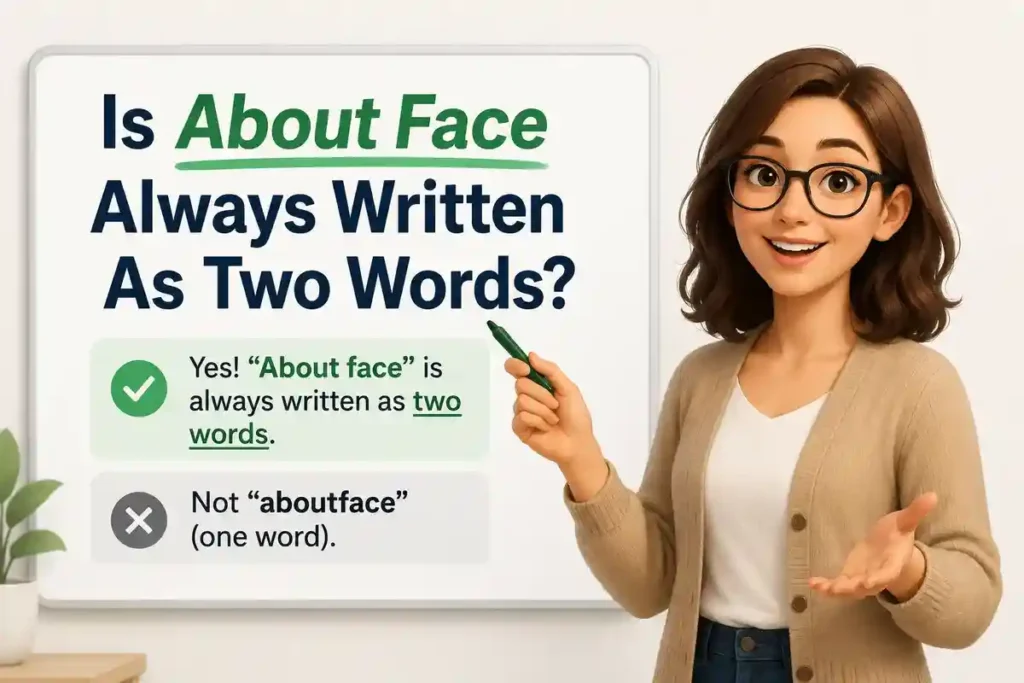
Is About Face Always Written As Two Words
Yes.
In standard American English, about face is written as two separate words when referring to the military command or the idiom.
Examples:
- The coach made an about face after halftime.
- The officer shouted, About face!
Keeping the words separate follows standard dictionary usage and editorial style guides.
Meaning About Face In Pronunciation
The pronunciation is straightforward once you hear the natural rhythm.
| Phrase | IPA | Simple Pronunciation |
|---|---|---|
| About face | /əˌbaʊt ˈfeɪs/ | uh BOUT FAYS |
The stress falls on face, while about is spoken more lightly.
When used as a military command, speakers often place strong emphasis on both words because it is an instruction rather than part of a sentence.
Example:
About FACE!
In everyday conversation, the phrase is spoken more naturally.
Example:
- The company made an about face after the product launch failed.
Usage Guide Of Meaning About Face
The expression about face works best when someone makes a clear and noticeable reversal. It is stronger than simply saying someone changed their mind because it suggests a dramatic shift from one position to another.
Use Of Meaning About Face In Business
Companies often make an about face after market research, customer feedback, or unexpected financial results.
Examples:
- The company made an about face and canceled the price increase.
- Management did an about face after listening to employee concerns.
How to use Meaning About Face Politics
News organizations frequently use the phrase when politicians reverse their positions.
Examples:
- The senator made an about face on environmental policy.
- The government did an about face after public criticism.
Meaning About Face Usage In Sports
Coaches, teams, and athletes can also make an about face by changing tactics or strategies.
Examples:
- The team made an about face in the second half and focused on defense.
- The coach did an about face after realizing the original game plan wasn’t working.
Meaning About Face In Everyday Life
The idiom fits naturally in personal situations as well.
Examples:
- She made an about face after talking with her family.
- He did an about face and decided to stay at his current job.
- They made an about face after reading the contract more carefully.
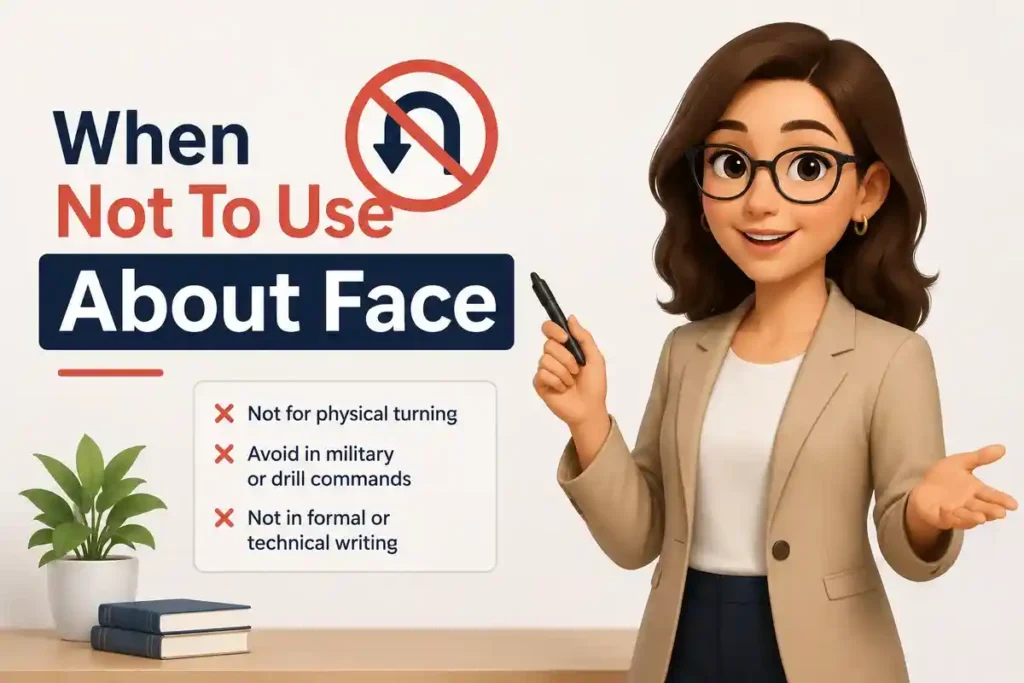
When Not To Use About Face
Avoid using about face when the change is small or gradual. The expression suggests a complete or significant reversal, so using it for a minor adjustment can sound exaggerated.
For example, if a restaurant adds one new item to its menu, describing it as an about face would feel inaccurate. A better choice would be updated the menu or made a small change. The idiom works best when the direction changes in a meaningful and obvious way.
Examples Of Meaning About Face In Different Contexts
One of the best ways to understand about face is to see how it works in different situations. Although the meaning stays the same, the context changes. In every example below, the phrase describes a clear reversal rather than a minor adjustment.
Business
Companies often make an about face after studying customer feedback, market trends, or financial performance.
Examples:
- The company made an about face and restored the original pricing plan.
- Management did an about face after employees raised concerns.
- The startup made an about face and focused on software instead of hardware.
- After weak sales, the retailer made an about face and expanded its online business.
Politics
Political reporting frequently uses this idiom because elected officials sometimes change their positions.
Examples:
- The governor made an about face on tax reform.
- The candidate did an about face after public opinion shifted.
- Lawmakers made an about face and supported the revised bill.
- The administration’s about face surprised both supporters and critics.
Workplace
The phrase also fits professional settings when leaders or teams reverse an important decision.
Examples:
- The director made an about face during the meeting.
- Our manager did an about face after reviewing the new data.
- The company announced an about face in its hiring policy.
- Leadership made an about face and approved remote work.
Sports
Athletes and coaches regularly change strategies during a season or even during a single game.
Examples:
- The coach made an about face and switched to a defensive lineup.
- The team did an about face after halftime.
- The manager’s about face helped the club recover from an early deficit.
- Fans praised the coach for making an about face before the playoffs.
Everyday Life
People often use the idiom when talking about personal decisions.
Examples:
- She made an about face and accepted the job offer.
- He did an about face after talking with his family.
- We made an about face and decided not to move.
- They made an about face after reading the contract carefully.
USAs Of Meaning About Face News And Media
Journalists use about face to describe dramatic changes because it immediately tells readers that something significant has happened.
Examples:
- The company made an about face on its return policy.
- The airline’s about face followed weeks of customer complaints.
- The organization did an about face after receiving new evidence.
- Experts described the decision as a complete about face.
Common Mistakes Of Meaning About Face
Although about face is a simple expression, writers occasionally misuse it. Most mistakes happen because people focus on the individual words instead of the meaning of the idiom.
Mistake One
❌ He made an about face by arriving five minutes earlier.
✅ He made an about face by changing his decision completely.
Why it is incorrect.
Arriving a few minutes early is a small adjustment. An about face describes a major reversal.
Mistake Two
❌ She made about face on the proposal.
✅ She made an about face on the proposal.
Why it is incorrect.
The idiom normally takes the article an when used as a noun phrase.
Mistake Three
❌ The company made an about face because it changed the logo color.
✅ The company made an about face because it completely changed its business strategy.
Why it is incorrect.
Changing a logo color is usually too minor to describe as an about face.
Mistake Four
❌ He performed an about face in the meeting by correcting one sentence.
✅ He performed an about face by reversing his entire position during the meeting.
Why it is incorrect.
The phrase implies a complete change, not a small correction.
Mistake Five
❌ About face means looking at someone’s face.
✅ About face means making a complete reversal or turning around.
Why it is incorrect.
The idiom has nothing to do with facial appearance.
Why People Get Confused In Using The Word Meaning About Face
Most people understand the figurative meaning after hearing the phrase in context, but confusion still happens for several reasons.
The Words Meaning About Face Sound Literal
At first glance, about face appears to describe someone’s face or appearance.
In reality, the expression comes from a military command, not from facial features.
Many People Never Learn The Military Meaning
Without knowing its military origin, the idiom can seem unusual or confusing.
Once you understand that soldiers literally turn around after hearing the command, the figurative meaning becomes much easier to remember.
Meaning About Face Is Sometimes Written As One Word
Some writers mistakenly use aboutface as a single word.
Most modern dictionaries and style guides treat about face as two words.
People Use Meaning About Face For Small Changes
One of the most common mistakes is using the idiom for minor adjustments.
An about face suggests a dramatic shift. Small changes or gradual improvements usually require different expressions.
Meaning About Face For Memory Tricks
Simple memory techniques can help you remember both the meaning and the origin of this idiom.
Picture A Soldier Turning Around
Imagine a line of soldiers standing at attention.
A commanding officer shouts About face!
Every soldier immediately turns 180 degrees to face the opposite direction.
That physical movement perfectly illustrates the figurative meaning of making a complete reversal.
Think About Changing Direction
Instead of focusing on the word face, think about changing direction.
Whenever someone completely changes an opinion, decision, or plan, they have made an about face.
Remember The Degree Of Change
Ask yourself one question.
Did the person make a complete reversal or just a small adjustment?
If it is a complete reversal, about face is probably the right expression.
If it is only a minor change, another phrase will sound more natural.
Regional Usage
The meaning of about face remains the same across major English speaking countries, although some regions favor different expressions in everyday conversation.
American English
American English uses about face regularly in newspapers, business writing, political reporting, and casual conversation.
Examples:
- The company made an about face on its pricing policy.
- The senator did an about face after meeting with voters.
British English
British English recognizes about face, but many speakers also use about turn in both military and figurative contexts.
Examples:
- The government made an about turn on energy policy.
- The minister performed an about turn after public criticism.
Although about turn is more common in the United Kingdom, British readers fully understand about face.
Canadian English
Canadian English uses both expressions, though about face appears more frequently in North American publications.
Australian English
Australian English also understands about face, but about turn is common in everyday speech and news reporting.
If you’re writing primarily for an American audience, about face is the better choice. For British or Australian readers, about turn may sound slightly more natural.
Etymology And History
The phrase about face has its roots in military drill commands that date back several centuries.
In military training, soldiers receive commands that require precise and coordinated movements. One of those commands is about face, which instructs them to turn 180 degrees and face the opposite direction in a single motion.
Over time, English speakers began using the command figuratively. Instead of describing a physical turn, it came to describe a dramatic change in opinion, policy, behavior, or direction.
Today, the idiom appears far more often in its figurative sense than in its original military context. News organizations, business leaders, educators, and everyday speakers all use it to describe significant reversals, showing how a specialized military command evolved into a widely recognized English expression.
Expert Language Insights
Experienced editors use about face carefully because it carries more weight than many similar expressions. It tells readers that someone has made a noticeable reversal, not just a routine adjustment.
When choosing this idiom, consider the size of the change. If a company completely abandons one strategy for another, about face is an excellent choice. If it simply updates a policy or makes a minor improvement, expressions like changed course, revised the plan, or made an adjustment are usually more accurate.
Editors also pay attention to audience. In American English, about face feels familiar and natural. For readers in the United Kingdom or Australia, about turn may sound slightly more idiomatic, although both expressions are widely understood.
Related Words Synonyms Antonyms And Similar Idioms
Learning related expressions helps you understand about face more naturally. Some words are close in meaning, while others describe different kinds of change. Knowing the difference helps you choose the most accurate expression for your writing.
Synonyms
These words and phrases can replace about face in the right context.
- Reversal.
- Turnaround.
- Change of direction.
- Policy reversal.
- Complete change.
- Shift in position.
- Change of heart.
- U turn.
- Backtrack.
- Reverse course.
- Retrace one’s steps.
- Change one’s mind.
Although these expressions are similar, they are not always interchangeable. For example, change of heart usually describes an emotional or personal decision, while about face often suggests a broader change in policy, strategy, or opinion.
Antonyms
These expressions describe the opposite idea.
- Stay the course.
- Remain consistent.
- Hold firm.
- Stand by a decision.
- Maintain the same position.
- Continue as planned.
- Keep the original direction.
These phrases are useful when someone refuses to change direction despite criticism or new information.
Common Collocations
Certain word combinations appear frequently with about face.
- Make an about face.
- Do an about face.
- Complete about face.
- Sudden about face.
- Dramatic about face.
- Political about face.
- Strategic about face.
- Unexpected about face.
- Public about face.
- Corporate about face.
Using these natural combinations makes your writing sound more fluent and idiomatic.
Similar Idioms
English has several idioms that express a similar idea, but each has its own nuance.
Change Course
This phrase suggests choosing a different direction without implying a complete reversal.
Example:
- The company changed course after reviewing customer feedback.
Change Of Heart
This idiom describes a personal or emotional shift in feelings or decisions.
Example:
- She had a change of heart and accepted the invitation.
Reverse Course
This expression is common in business, politics, and journalism when someone abandons an earlier decision.
Example:
- The government reversed course after widespread criticism.
Backtrack
Backtrack often suggests withdrawing a previous statement or position, sometimes because of pressure or new evidence.
Example:
- The spokesperson backtracked after the interview received negative attention.
U Turn
In American English, U turn can describe both a literal traffic maneuver and a complete change in opinion or policy.
Example:
- The company made a U turn on its return policy.
For readers in the United Kingdom, about turn is another common alternative.

Practical Writing Tips
Using about face correctly is mostly about choosing the right situation. These practical tips can help you sound more natural and precise.
- Use the idiom only when the change is significant, not when someone makes a small adjustment.
- Make sure readers can see what changed. Explain the original position before describing the reversal.
- Use made an about face or did an about face in everyday writing because these are the most familiar combinations.
- Avoid repeating the idiom several times in the same article. Mix in alternatives like reversed course, changed direction, or made a dramatic shift to improve readability.
- Consider your audience. If you’re writing for American readers, about face sounds natural. For readers in the United Kingdom or Australia, about turn may feel more familiar.
- Keep the tone in mind. The idiom works well in journalism, business writing, political analysis, and conversational English, but it may sound too informal for highly technical or legal documents.
Frequently Asked Questions
What Does About Face Mean
About face means making a complete change in direction, opinion, decision, or behavior. It originally referred to a military command that tells soldiers to turn around and face the opposite direction.
Is About Face An Idiom
Yes. Outside military contexts, about face is an idiom. It describes a dramatic reversal rather than a literal physical movement.
Where Did About Face Come From
The phrase comes from military drill commands. Soldiers respond to the command about face by turning 180 degrees. Over time, English speakers began using it figuratively to describe major changes in opinion or direction.
Is About Face Still Used Today
Yes. The idiom is widely used in American English. You’ll often see it in newspapers, business articles, political reporting, sports commentary, and everyday conversations.
Is About Face Formal Or Informal
It works well in both formal and informal writing. Journalists, business professionals, and everyday speakers all use the expression naturally when describing a significant reversal.
What Is The Difference Between About Face And Change Of Heart
Both describe change, but they are not identical.
A change of heart usually involves emotions or personal feelings. An about face often refers to a broader reversal in policy, strategy, opinion, or behavior.
Is About Face The Same As About Turn
The meanings are the same.
About face is more common in American English, while about turn is used more often in British and Australian English.
Can About Face Be Used As A Verb
No.
The phrase itself is not normally used as a verb. Instead, writers pair it with verbs such as make, do, or perform.
Examples:
- The company made an about face.
- The coach did an about face.
Can About Face Describe A Person
Yes.
It can describe an individual, a company, a government, a sports team, or any group that makes a significant change in direction.
Is About Face Always Negative
No.
The idiom is neutral. An about face can be positive, negative, or simply necessary. The phrase describes the size of the change rather than judging the decision itself.
Conclusion
The meaning of about face becomes clear once you understand its military origin. What began as a command telling soldiers to turn 180 degrees has evolved into a widely used idiom that describes a complete reversal in direction, opinion, policy, or behavior. Today, you’ll find it in news reports, business discussions, political analysis, sports commentary, and everyday conversations whenever someone makes a significant change.
The key is to use the expression only when the shift is substantial. Minor adjustments or routine updates usually don’t qualify as an about face. If a person, organization, or government abandons one position and adopts another, the idiom fits naturally. Understanding that distinction will help you recognize the phrase in context and use it confidently in your own writing.

Founding Editor
Maya spent six years as a copyeditor at a regional newspaper before starting Grammist, which is where the “answer first” format came from: newsroom style guides don’t have room for a preamble.
She writes and reviews most of the word-pair and spelling entries, and has final say on anything that goes out under the Grammist name.